Showing posts with label student. Show all posts

Monday, September 29, 2014

Shanghai School System


China has a long custom of admiration for instruction. Truth be told, there is much societal and family weight to do well scholastically. This has cultivated instruction change all through history at numerous levels. While the whole nation has made strides in instruction, Shanghai is at the cutting edge as it has been given uncommon power to explore different avenues regarding change before whatever remains of the nation. With its late rankings at the highest point of the PISA 2009 exam, everyone's eyes will be on how these changes were made. 

Shanghai, the biggest city in China, was the first to accomplish one hundred percent essential and lesser secondary school enlistment. It was one of the first to attain very nearly general auxiliary school participation. Additionally remarkable is that all understudies in Shanghai who need to go to some sort of advanced education have the capacity do so. General training included including offspring of vagrant laborers from rustic ranges of the nation – adding up to 21 percent of school youngsters in the city. (With a populace of about 20 million, that is almost four million transient school youngsters.) In different parts of China, these kids may be seen as an issue. Shanghai, on the other hand, is a city filled by transients, and it grasped this populace and coordinated these youngsters into its classrooms. 

China's training framework has attempted to move far from the exam-based framework that drives educational module and brings about remembering realities to breeze through the test. In 1985, Shanghai started a methodology of change and made exams that test the application of genuine aptitudes. Different decision addresses no more show up on the city's exams. 

Notwithstanding the changes, exams still exist. An expected 80 percent of understudies go to night and weekend "pack schools" to guarantee that they pass. This comes notwithstanding daily homework and extracurricular exercises – making the life of a Chinese understudy overpowering. The focal Chinese government is mindful of this countrywide issue and its new 2020 change endeavors require a lessening in understudy workload. Shanghai is furthermore attempting to enhance understudies' instruction encounter with the goal that they figure out how to learn and not simply realize numerous actualities. A redesigned educational module is at the core of this methodology. 

Starting in 1985, trying to move far from the high-weight exam framework and build the nature of instruction, Shanghai started to permit understudies to take elective courses, which prompted new course readings and materials. Actualized in 2008, a recharged exertion to support understudy adapting as opposed to aggregation of learning, prompted eight curricular "learning spaces": 

  1. dialect and writing 
  2. arithmetic 
  3. common science 
  4. social sciences 
  5. innovation 
  6. expressions 
  7. physical instruction 
  8. practicum 


Schools were then urged to make their own particular educational module and outside gatherings, for example, galleries got to be accomplices in instruction. Some piece of the new educational program incorporates an attention on request based training. Understudies freely investigate research points of enthusiasm to themselves so as to push social wellbeing, imaginative and discriminating considering, and once more, figuring out how to learn. 

To backing the new instruction changes, certificate forms for educators were actualized. Instructor proficient improvement necessities additionally expanded – instructors in Shanghai should now finish 240 hours of expert advancement in five years. An online database gives help configuration and usage of educational module, examination papers, and best practice samples. Educators are presently swayed to permit time for understudy exercises in classrooms rather depending exclusively on presentations. 

One fascinating system utilized by Shanghai to enhance powerless schools is the authorized instruction program. Under this plan, top performing schools are appointed a feeble school to oversee. The "great" school will send a group of instructors and a key to lead the school and enhance it. This has been occurring inside the city additionally as a sort of trade system with poor country schools. Such a framework supports the poor schools and profits Shanghai schools by permitting them to push educators and directors. 

In both Shanghai and Hong Kong, there is an agreeable mindfulness that instruction needs to change to keep pace with the rate of progress in the public eye – and current change, as well as a cognizant exertion has been made to consider the fate of society, the economy, and training. This forward intuition outlook ought to impact the United States as No Child Left Behind (NCLB), the law representing essential and optional training, as the ten year old is going to be reauthorized.

South Korea Education


Essential Education 

Kindergarten is nonobligatory in South Korea and most folks want to keep their minimal ones at home as far as might be feasible. In any case, at age 6 their tyke must proceed onward to 6 years obligatory chodeung-hakgyo basic instruction. There they learn subjects like English, Fine Arts, Korean, Maths, Moral Education, Music, Physical Education, Practical Arts, Science and Social Studies, normally all exhibited by a solitary instructor. A few folks send their kids to private hagwon schools nightfall, where English may be better taught. 

Center Education 

Puts in auxiliary schools are granted by lottery and everyone gets an equivalent shot. The move to 3 years of center school might be troublesome in light of the fact that studies are considered much more important. Order is stricter too with outfits, hair stylings and timeliness strictly authorized. This time however, expert instructors move between classrooms showing center subjects, including English, Korean, Maths, also Social Science and Pure Science. Discretionary projects incorporate Art, Ethics, History, Home Economics, Music, Physical Education, Technology, and Hanja Chinese Characters. 

Auxiliary Education 

The last 3 years of school training occur at secondary schools. These may practice as per subjects taught (e.g. Science versus Languages), or present more general scholarly curriculae. Some are state claimed and some are secretly run. The nature of their results is unbelievable. Benchmarks are high. 

Professional Education 

Roughly 25% of center school graduates like to happen to professional schools where they are taught abilities in 5 fields including Agriculture, Commerce, Fishery, Home Economics and Technology. The first of 3 evaluations takes after a typical system, where after understudies practice. 

Tertiary Education 

The more prominent dominant part of Korean secondary school understudies compose a school educational capacity test with a perspective to concentrating on further. Models are high and a few understudies begin planning as right on time as in kindergarten years. The 5 segments of the test research learning of English, Korean and Maths, furthermore elective subjects, for example, Social Sciences, Physical Sciences and the Humanities. 

At college, understudies experience new guidelines of greatness and entire families get to be included in helping them to pass. At examination times, organizations even open for shorter hours in distinguishment of this. An understudy who passes however, has a capability that meets top global benchmarks, and of which he or she may be legitimately pleased. Korea - living evidence of the force of a learning based economy.

Difference Of University And TAFE In Australia


University

University degrees give particular expert conclusions. 
Courses invest more of a chance on speculations, with the goal that you have a system for examining and taking care of issues in your field of study. 
Anyway its not all hypothesis. At some universities you'll be given numerous chances to place hypothesis into practice through work arrangements and capstone ventures. 
A key distinction in the middle of school and college is that the learning environment is substantially less organized. You pick when to study and how hard to inspire yourself. 
While address times are plainly situated out, the obligation – to go to, to do homework, to do the exploration, to study additional hours – is yours.

TAFE

TAFE courses are more centered around learning for work and by and large learning at work. 
The instructing is focused around supporting you to increase particular aptitudes, so there are: 


  • More contact hours 


  • More diminutive classes 


  • More individual contact with your instructors 


The abilities you learn are straightforwardly significant to performing undertakings in the work environment and are gone for enhancing your employability, and capability to adjust to evolving work.

Israel Education System


As a nation needing in regular assets, Israel's future relies on upon its instructive framework and the preparation of intellectual competence. Following in the strides of eras of Jews, instruction is a valuable legacy, and Israel's instructive framework and plenty of establishments of advanced education bear witness to that. 

The State Hebrew instructive framework (mamlachti/ mamlachti dati) is focused around the Jewish schedule and tries to confer city values, Jewish legacy, an abnormal state of mechanical and logical abilities, and wide based learning. Notwithstanding adherence to a fundamental state educational module, there are extraordinary contrasts among schools. The Ministry of Education is included in a continuous procedure of aligning instructive guidelines with cutting edge pedagogical practices, for example, ordering sex fairness, growing humanistic curricula and advertising logical and mechanical studies. In any case, decreasing substantial class sizes and drawing gifted teachers into the showing pool are quick needs that must be went to attain the Ministry's long- and fleeting pedagogical objectives. 

One of Israel's most pressing difficulties is to give square with circumstances in instruction to all youngsters. In this nation of differentiations, the instructive framework is a vexing confirmation to exactly how wide the crevices are in Israeli society. While a Jewish youngster in the focal piece of the nation may go to a school with gardens, stone pathways and flowerbeds, classes of close to 28 students, air- molding, state of the workmanship machine and expressive arts offices, a dynamic educational module and accomplished instructors; a Bedouin kid in the Negev will probably go to class in a ramshackle building with no meeting expectations toilets, and in the wake of having strolled kilometers to get there, will sit in unheated or unairconditioned classrooms of in excess of 40 understudies. The test is extraordinary, and little by little, Israel is contributing the stores and assets to in the long run bring all schools to a level of brilliance. 

At the point when the State of Israel was established (1948), a completely working Hebrew instructive framework existed, constructed and kept up by the Yishuv, the prestate Jewish group. These schools had effectively met the difficulties of restoring the Hebrew dialect and incorporating the olim who came to Palestine. 

In the course of recent years, Israel has invited in excess of over two million workers, and its school populace has expanded more than tenfold. Consequently the instructive framework has been practically constantly confronted with the colossal test of incorporating extensive quantities of kids from diverse social foundations. In the 1950s, most foreigners originated from post-war Europe and Arab nations, in the 1960s from North Africa and in the 1970s, 80s and 90s from the previous Soviet Union and Ethiopia. Throughout the decades, newcomers have additionally touched base from the Americas and different parts of the free world. 

Notwithstanding taking care of earnest requests for more classrooms and qualified instructors for the quickly expanding number of understudies, the instructive framework has attempted to create suitable systems to help assimilate the newcomers which incorporate instructor preparing projects outfitted towards working with outsider students; get ready unique curricular supports; opening transient classes to acquaint settler understudies with subjects not adapted in their nations of cause, for example, the Hebrew dialect and Jewish history; and offering retraining courses to migrant educators to encourage their occupation in the training framework.

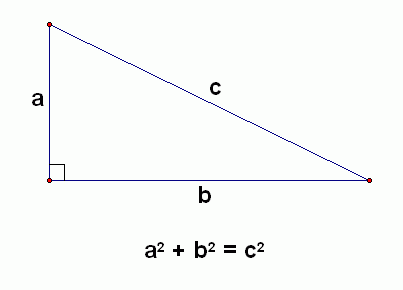
The Pythagoras Theorem


A while ago when you initially considered square attaches and how to tackle radical comparisons, you were presumably acquainted with something many refer to as "the Pythagorean Theorem". This Theorem relates the lengths of the three sides of any right triangle. 

The legs of a right triangle (the two sides of the triangle that meet at the right plot) are usually named as having lengths "a" and "b", and the hypotenuse (the long side of the triangle, inverse the right edge) is marked as having length "c". The lengths are connected by the accompanying comparison: 

a2 + b2 = c2 

This mathematical statement permits you to discover the length of a side of a right triangle when they've provided for you the lengths for the other two sides, and, going in the other heading, permits you to figure out whether a triangle is a right triangle when they've provided for you the lengths for every one of the three sides.

Math And Science Training In South Africa Is The Worst In The World


The nature of South Africa's maths and science instruction places it last out of 148 nations, as indicated by a World Economic Forum report. 

Under the "abilities" sub-class, the nature of South Africa's maths and science training comes in last place, behind any semblance of Haiti, Lesotho, Chad, Zimbabwe, Nigeria, and Kenya. 

The nature of South Africa's instruction places it in 146th spot. 

This is as indicated by the "Worldwide Information Technology Report 2014". It utilizes an arranged availability record (NRI) to rank the state of nations' data and correspondence innovation. 

South Africa is set 70th on the NRI, which is made up of 10 diverse sub-classes from which the general NRI positioning is drawn. 

Popularity based Alliance training representative Annette Lovemore said in an announcement she would try to have Basic Education Minister Angie Motshekga brought before Parliament. 

This was so the pastor could represent what seemed, by all accounts, to be the exacerbating state of South Africa's training framework. 

She said the clerical undertaking group secured to explore educating in maths, science and engineering a year ago discharged an "accursing report" about South Africa's training. 

"[the ecclesiastical report] uncovered expanding openings at each level of our instruction framework," said Lovemore. 

It noted that the national system was out of date, there was a lack of qualified instructors, and educational program changes throughout the most recent 10 years had contrarily influenced instructing. 

Colleges were not preparing educators satisfactorily, and region officers were to a great extent not able to give sufficient backing to instructors. 

"Moreover, an answer to a resulting DA parliamentary inquiry uncovered that the bureau of essential instruction does not know the full degree of the deficiencies of arithmetic, science and engineering educators," she said. 

"In all actuality Basic Education Minister Angie Motshekga has not done what's needed to address the maths, science and innovation emergency." 

The WEF's positioning did not reflect the capacity of South Africa's school students, yet an instruction framework that required dire intercession. 

The instruction educational program and system must be adjusted to attain comparative triumphs in South Africa as had been seen in the Western Cape, said Lovemore. 

Here, the 2013 matrics attained a 73.3% pass rate in maths and 73.7% in science. 

"Quality instruction is a significant need for making all the more all inclusive aggressive adolescent grown-ups, tremendously required occupations and ambitious people," she said.

Facts About Finland's Education System


Since it executed tremendous instruction changes 40 years back, Finland's educational system has reliably taken a swing at the top for the universal rankings for training frameworks. 
So how would they isn't that right? 
It's basic — by going against the assessment determined, concentrated model that a great part of the Western world employments. 


  1. Finnish youngsters don't begin school until they are 7. 
  2. Contrasted and different frameworks, they once in a while take exams or do homework until they are a ways into their youngsters. 
  3. The youngsters are not measured at all for the initial six years of their instruction. 
  4. There is one and only obligatory state sanctioned test in Finland, taken when youngsters are 16. 
  5. All youngsters, shrewd or not, are taught in the same classrooms. 
  6. Finland uses around 30 percent less for every understudy than the United States. 
  7. 30 percent of kids get additional help amid their initial nine years of school. 
  8. 66 percent of understudies head off to college. 
  9. The contrast in the middle of weakest and strongest understudies is the most diminutive in the World. 
  10. Science classes are topped at 16 understudies so they may perform useful examinations each class. 
  11. 93 percent of Finns move on from secondary school. 
  12. 43 percent of Finnish secondary school understudies go to professional schools. 
  13. Basic school understudies get 75 minutes of break a day in Finnish versus a normal of 27 minutes in the US. 
  14. Instructors just use 4 hours a day in the classroom, and take 2 hours a week for "expert improvement". 
  15. Finland has the same measure of educators as New York City, yet far less understudies. 
  16. The educational system is 100% state supported. 
  17. All educators in Finland must have a bosses degree, which is completely financed. 
  18. The national educational program is just expansive rules. 
  19. Instructors are chosen from the main 10% of graduates. 
  20. In 2010, 6,600 candidates vied for 660 elementary school preparing openings 
  21. The normal beginning pay for a Finnish educator was $29,000 in 2008 
  22. In any case, secondary teachers with 15 years of experience make 102 percent of what other school graduates make. 
  23. There is no legitimacy pay for educators 
  24. Educators are successfully given the same status as specialists and legal advisors 
  25. In a global institutionalized estimation in 2001, Finnish kids verged on the top for science, perusing and math. 
  26. Furthermore regardless of the contrasts in the middle of Finland and the US, it effectively beats nations with a comparable demograph

Advantages Of Scholarship


There are various effective preferences to getting grants. On the off chance that you have the capacity get a grant that covers both your educational cost, books, and essential living costs, you can concentrate on finishing your degree without needing to take out credits or land a position to pay for your classes. Notwithstanding, grants are not simple to get. Not at all like understudy advances, grants are not vigorously promoted. 

Getting a decent grant could be testing, and actually disappointing. Nonetheless, the prizes of getting the grant are worth the difficulties. In this article, I need to head over a percentage of the key points of interest of getting grants. The main playing point of getting a grant is expense. 

It isn't much of a mystery that the expenses of instruction have kept on riing in the most recent 20 years. This has made it harder for understudies from low pay families go to school, and some have even went the extent that to say that this has brought about a bigger riches crevice in the public eye, since the individuals who are taught tend to show signs of improvement paying employments. While most universities and colleges are fast to talk understudies into taking out credits to pay for their training, few of them will say grants, unless understudies are smart enough to get some information about them. There are various reasons why you will need to get a grant instead of an understudy advance. 

Studies have demonstrated that it takes the normal understudy 10 years to pay off their understudy advances once they've moved on from school with a lone rangers, experts, or doctorate. This will by and large be a huge number of dollars that will need to be paid again, in addition to premium. Over the long haul, this is cash that will be hauled out of the understudies pocket. With grants, the understudy doesn't need to pay back anything. When they graduate, begin their professions, and start gaining cash, they can keep the cash they procure without needing to reimburse it. An alternate key preference of grants is that it permits understudies to stay away from what I call the "school work difficulty." 

The school work predicament is something that numerous understudies from low pay families are acquainted with. Once these understudies move on from secondary school, they must arrangement with how they can go to school while attempting to help themselves. Since the money related help they may be given is insufficient to pay for 100% of their educational cost, some of these understudies may be compelled to work 30 to 40 hours for every week while attempting to learn in the meantime. Since they are regularly tired after work, they fall behind on their studies, and some even leave school. Regardless of the fact that the understudy can complete school, the "school work difficulty" will place them in a circumstance where it takes more time for them to get their degree contrasted with an understudy who can pay for their classes in advance without needing to work a day work. 

The "school work situation" isn't constrained to understudies from low salary families. Understudies who originate from affluent families, yet who have folks that decline to store their training, are additionally placed in a circumstance where they need to manage the school work predicament. An understudy who is in either circumstance could profit from getting a grant. They would have the capacity to take care of all the real expenses of their training, and they could work possibly 10 to 15 hours for every week, concentrating on their studies. Above all, the cash doesn't need to be paid back. 

An alternate capable focal point of grants is their distinction. Since most grants oblige understudies to keep up decent evaluations to keep them, it takes a lot of obligation to utilize them successfully. 

When an understudy graduates from school with a grant, potential head honchos will be exceptionally inspired with they read the resumes of these understudies. The explanation behind this is on account of the understudies indicated obligation and train by having the capacity to get the advance. A candidate who acquired their training through a grant is profoundly regarded according to most potential managers. Grants are not simple to get, and this is the reason they are so important. Interestingly, understudy credits are much simpler to get, however they will be a great deal all the more expensive over the long haul. Grants are influential budgetary instruments that understudies must use in the event that they wish to graduate without owing a lot of cash.

Sunday, September 28, 2014

Trade School Or College?


For quite a few people, heading off to a four year school would appear to be a programmed decision when they move on from secondary school. The reason is self-evident more wage. As per the National Center for Educational Statistics, a professional education represented $15,000 in extra wage for every year versus a secondary school certificate ($30,000 versus $45,000). Over a thirty year vocation in the workforce, that signifies a $450,000 distinction.

This post initially showed up on The Simple Dollar. 

Notwithstanding, there are a couple of downsides with this blissful picture. For one thing, a four year certification regularly takes four years of study, which implies that individuals who enter the workforce in the wake of getting their four year college education aren't doing so until age 22. That shaves a few years off of an individual's vocation. An alternate downside is the expense. The normal four year certification in the United States costs $127,000.

A third downside: some individuals basically aren't arranged for the rigors of a four year school. The Institute of Education Statistics assesses that 40% of actively present people at a four year school drop out before finishing their degree. On the off chance that you end up as a piece of that 40%, not just have you caused a percentage of the cost of school, you cleared out without getting a degree.

My reaction to these detail is that individuals approaching secondary school graduation ought to genuinely consider exchange school, especially on the off chance that they're not at the highest point of their class. Exchange school offers a really convincing profession way, especially contrasted with the school way portrayed previously.

For one thing, the compensation isn't that much of a drop-off contrasted with a four year degree. Simplyhired.com appraises that an exchange school graduate will make about $42,000 for every year. Throughout the span of thirty years, the contrast between that exchange school graduate and the four year school graduate is just $90,000.

An alternate variable that assists with exchange school is that you'll enter the workforce two years prior. That adds up to two extra years of salary in which the exchange school graduate will make, generally speaking, an alternate $42,000 every year, signifying $84,000. That implies that at age 52 (following 30 years in the workforce versus 32 for the exchange school graduate), the school graduate might be ahead by $6,000 on lifetime wage, actually barring the credit.

In the meantime, the normal exchange school degree costs $33,000, which, contrasted with a $127,000 four year certification, implies a funds of $94,000. In any case that is not all! In the event that you expect that these understudies are completely financing their training with advances at 4% in excess of ten years, the four year college education will cost $154,000, while the exchange school degree will cost just $40,000. That is a reserve funds of $114,000 just on the degree. Obviously, most understudies in both cases won't completely back their training. They'll work and discover different wellsprings of wage to help with the methodology, importance the hole will be more diminutive in the normal case.

Yet an alternate point of interest of an exchange school is that the vast majority of the employments you'll get are to a great degree hard to fare to an alternate nation. It is much less demanding to fare, say, machine programming work or other data economy work than it is to fare carpentry or electrical work.

It ought to be noted that I'm not restricted to a four year degree; rather, I'm essentially putting forth a solid defense for an alternative that numerous individuals neglect when choosing what to do after secondary school. The focal points of a four year degree are various: you're going to gain significantly all the more later on in life and you likewise have the entryway completely open to proceed with your studies and win generously more with a bosses degree or doctorate. Exchange school graduates are extremely constrained on chances to keep on bolsterring their instruction.

I'll abandon you with an account. My wife's cousin moved on from secondary school at generally the same time my wife graduated. Her cousin went to circuit repairman's school, while my wife set off for college. Her cousin began working three prior years my wife and caused a great deal less understudy advance obligation. Today, he makes a tad bit short of what her, yet the distinction isn't excessively, in addition to he had almost no obligation after school. This past May, my nephew moved on from secondary school. He's currently going to circuit tester's school too. I think its the smartest move he could have made.

In case you're moving on from secondary school soon, ponder exchange school. On the off chance that you have a friend or family member who's approaching graduation, sway them to at any rate consider exchange school as an alternative.

I'll abandon you with an account. My wife's cousin moved on from secondary school at generally the same time my wife graduated. Her cousin went to circuit tester's school, while my wife attended an university. Her cousin began working three prior years my wife and brought about significantly less understudy credit obligation. Today, he makes a tiny bit short of what her, however the distinction isn't excessively, in addition to he had almost no obligation after school. This past May, my nephew moved on from secondary school. He's presently going to circuit repairman's school also. I think its the most astute move he could have made.

In case you're moving on from secondary school soon, contemplate exchange school. On the off chance that you have a friend or family member who's approaching graduation, sway them to at any rate consider exchange school as a choice.

I'll abandon you with a tale. My wife's cousin moved on from secondary school at generally the same time my wife graduated. Her cousin went to circuit repairman's school, while my wife headed off to college. Her cousin began working three prior years my wife and caused a great deal less understudy advance obligation. Today, he makes a tiny bit short of what her, however the distinction isn't excessively, in addition to he had next to no obligation after school. This past May, my nephew moved on from secondary school. He's presently going to circuit tester's school too. I think its the most astute move he could have made.

In case you're moving on from secondary school soon, contemplate exchange school. On the off chance that you have a friend or family member who's approaching graduation, sway them to at any rate consider exchange school as an option.